
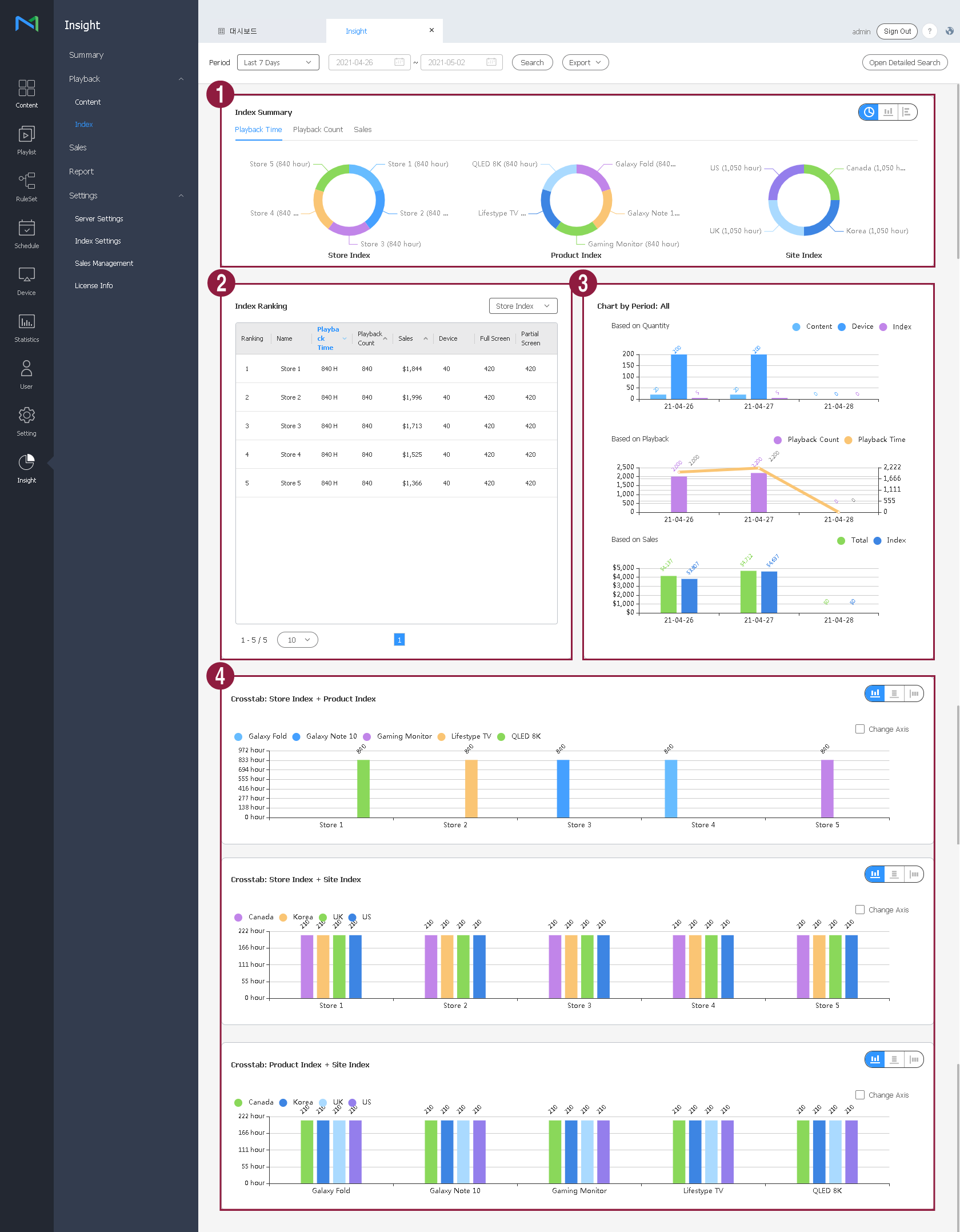
View the playback status for each index, e.g., an individual index or key index group, and the status of playback in which key indexes are combined. Retrieved data is shown in visual format, e.g., graphs and a table, so that you can obtain an intuitive view of index playback status by period.
- From the menu bar on the Insight screen, click Playback > Index .
Set the analysis period in the search area at the top. Analysis result is displayed based on the period specified in Settings > Index Settings > Date Range .
Note
- To select all data items or only analyze specific data items, click Open Detailed Search . It is possible to select specific device groups or key indexes, as well as a search period. It is also possible to analyze data collected during a maximum of 60 days within the last two years.
- Logs and processed data are retained for a maximum of two years.
Click Search . The statistics that match the search conditions are presented in graphs and a table.
- To save retrieved statistics as a PDF or HTML file, click Export .
Understanding retrieved data
The following data items are displayed.
| 1 | Index Summary | View indexes set as key indexes, based on the playback time, playback count, and sales. You can change the graph type by selecting a preferred graph type icon from the top right of the graph page. |
| 2 | Index Ranking | Shows the indexes that were played more frequently among individual key indexes or all indexes, based on the playback time. If there are ten or more indexes, move between pages to view indexes not shown on the current page. View the index rankings, index names, playback time, playback count, sales, devices used for playback, and full/split-screen playback details. You can view all key indexes or select specific key indexes to view.
|
| 3 | Chart by period |
|
| 4 | Cross-tabulation analysis | Select and combine specific key indexes to display the playback time and the relationship between individual indexes as graphs. If key indexes A, B, and C are selected, the screen displays graphs in which three different pairs (A-B, B-C, and C-A) are analyzed.
You can select a preferred type from the variety of graph types. You can also display information about specific indexes simply by clicking the index names at the top of the graph. |